简介

本文主要是针对新思的I2C控制器的学习的第二篇文章

本文涉及:
Uboot下I2C控制器驱动实现分析

OPS

1
2
3
4
5
6
7
8
9
10
11
12
13
14
15
16
17
18
19
20
21
22
static const struct dm_i2c_ops designware_i2c_ops = {
.xfer = designware_i2c_xfer,
.probe_chip = designware_i2c_probe_chip,
.set_bus_speed = designware_i2c_set_bus_speed,
};

static const struct udevice_id designware_i2c_ids[] = {
{ .compatible = "snps,designware-i2c" },
{ }
};

U_BOOT_DRIVER(i2c_designware) = {
.name = "i2c_designware",
.id = UCLASS_I2C,
.of_match = designware_i2c_ids,
.bind = designware_i2c_bind,
.probe = designware_i2c_probe,
.priv_auto_alloc_size = sizeof(struct dw_i2c),
.remove = designware_i2c_remove,
.flags = DM_FLAG_OS_PREPARE,
.ops = &designware_i2c_ops,
};

I2C驱动回调接口

designware_i2c_xfer

根据msg里的flags来决定具体执行read还是write接口

1
2
3
4
5
6
7
8
9
10
11
12
13
14
15
16
17
18
19
20
21
22
23
24
25
static int designware_i2c_xfer(struct udevice *bus, struct i2c_msg *msg,
int nmsgs)
{
struct dw_i2c *i2c = dev_get_priv(bus);
int ret;

debug("i2c_xfer: %d messages\n", nmsgs);
for (; nmsgs > 0; nmsgs--, msg++) {
debug("i2c_xfer: chip=0x%x, len=0x%x\n", msg->addr, msg->len);
if (msg->flags & I2C_M_RD) {
ret = __dw_i2c_read(i2c->regs, msg->addr, 0, 0,
msg->buf, msg->len);
} else {
ret = __dw_i2c_write(i2c->regs, msg->addr, 0, 0,
msg->buf, msg->len);
}
if (ret) {
debug("i2c_write: error sending\n");
return -EREMOTEIO;
}
}

return 0;
}

1
2
3
4
5
6
7
8
9
10
11
12
13
14
15
16
17
18
19
20
21
22
23
24
25
26
27
28
29
30
31
32
33
34
35
/*
* i2c_wait_for_bb - Waits for bus busy
*
* Waits for bus busy
*/
static int i2c_wait_for_bb(struct i2c_regs *i2c_base)
{
unsigned long start_time_bb = get_timer(0);

while ((readl(&i2c_base->ic_status) & IC_STATUS_MA) ||
!(readl(&i2c_base->ic_status) & IC_STATUS_TFE)) {

/* Evaluate timeout */
if (get_timer(start_time_bb) > (unsigned long)(I2C_BYTE_TO_BB))
return 1;
}

return 0;
}

static int i2c_xfer_init(struct i2c_regs *i2c_base, uchar chip, uint addr,
int alen)
{
if (i2c_wait_for_bb(i2c_base))
return 1;

i2c_setaddress(i2c_base, chip);
while (alen) {
alen--;
/* high byte address going out first */
writel((addr >> (alen * 8)) & 0xff,
&i2c_base->ic_cmd_data);
}
return 0;
}

read接口导读:

1
2
3
4
5
6
7
8
9
10
11
12
13
14
15
16
17
18
19
20
21
22
23
24
25
26
27
28
29
30
31
32
33
34
35
36
37
38
39
40
41
42
43
44
45
46
47
48
49
50
51
52
53
54
55
56
57
58
static int __dw_i2c_read(struct i2c_regs *i2c_base, u8 dev, uint addr,
int alen, u8 *buffer, int len)
{
unsigned long start_time_rx;
unsigned int active = 0;

#ifdef CONFIG_SYS_I2C_EEPROM_ADDR_OVERFLOW
/*
* EEPROM chips that implement "address overflow" are ones
* like Catalyst 24WC04/08/16 which has 9/10/11 bits of
* address and the extra bits end up in the "chip address"
* bit slots. This makes a 24WC08 (1Kbyte) chip look like
* four 256 byte chips.
*
* Note that we consider the length of the address field to
* still be one byte because the extra address bits are
* hidden in the chip address.
*/
dev |= ((addr >> (alen * 8)) & CONFIG_SYS_I2C_EEPROM_ADDR_OVERFLOW);
addr &= ~(CONFIG_SYS_I2C_EEPROM_ADDR_OVERFLOW << (alen * 8));

debug("%s: fix addr_overflow: dev %02x addr %02x\n", __func__, dev,
addr);
#endif

if (i2c_xfer_init(i2c_base, dev, addr, alen))
return 1;

start_time_rx = get_timer(0);
while (len) {
if (!active) {
/*
* Avoid writing to ic_cmd_data multiple times
* in case this loop spins too quickly and the
* ic_status RFNE bit isn't set after the first
* write. Subsequent writes to ic_cmd_data can
* trigger spurious i2c transfer.
*/
if (len == 1)
writel(IC_CMD | IC_STOP, &i2c_base->ic_cmd_data);
else
writel(IC_CMD, &i2c_base->ic_cmd_data);
active = 1;
}

if (readl(&i2c_base->ic_status) & IC_STATUS_RFNE) {
*buffer++ = (uchar)readl(&i2c_base->ic_cmd_data);
len--;
start_time_rx = get_timer(0);
active = 0;
} else if (get_timer(start_time_rx) > I2C_BYTE_TO) {
return 1;
}
}

return i2c_xfer_finish(i2c_base);
}

designware_i2c_probe_chip

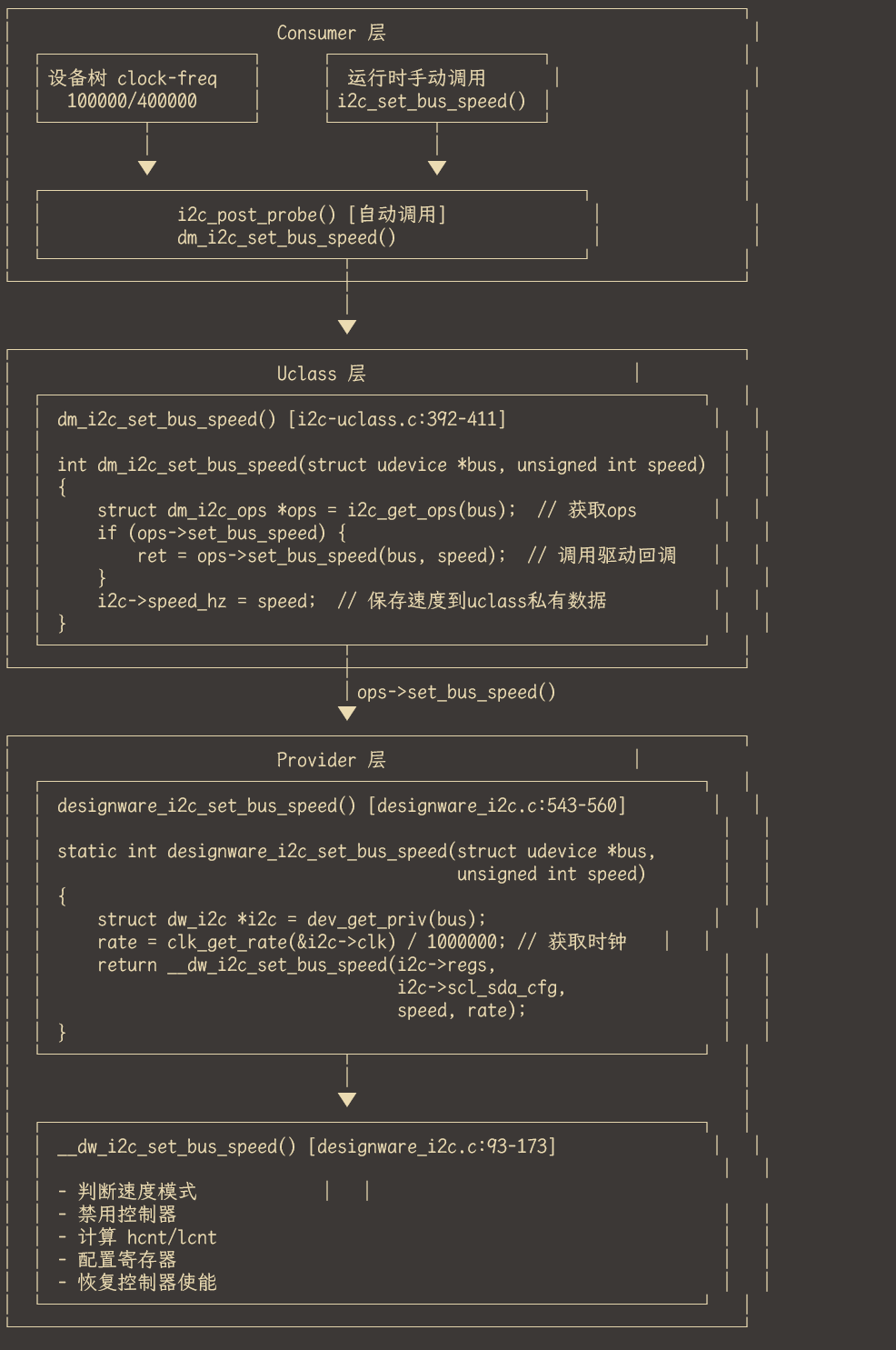
designware_i2c_set_bus_speed

整体架构:
超时机制

超时处理机制详解

该驱动中有多个关键的超时检查点,防止在异常情况下系统死锁。

  1. 控制器使能/禁用超时 (第64-84行)
1
2
3
4
5
6
7
8
9
10
11
12
13
14
15
16
17
18
19
20
21
static int dw_i2c_enable(struct i2c_regs *i2c_base, bool enable)
{
u32 ena = enable ? IC_ENABLE_0B : 0;
int timeout = 100;

do {
writel(ena, &i2c_base->ic_enable);
if ((readl(&i2c_base->ic_enable_status) & IC_ENABLE_0B) == ena)
return 0;

/*
* Wait 10 times the signaling period of the highest I2C
* transfer supported by the driver (for 400KHz this is
* 25us) as described in the DesignWare I2C databook.
*/
udelay(25);
} while (timeout--);
printf("timeout in %sabling I2C adapter\n", enable ? "en" : "dis");

return -ETIMEDOUT;
}

目的:使能/禁用控制器时,硬件可能需要时间响应,通过轮询 ic_enable_status 寄存器确认状态变化。

机制:

  • 最多重试 100 次
  • 每次间隔 25µs(400KHz I2C 信号周期的 10 倍)
  • 总超时时间约 2.5ms

  1. 等待总线空闲超时 (第208-221行)
1
2
3
4
5
6
7
8
9
10
11
12
13
14
static int i2c_wait_for_bb(struct i2c_regs *i2c_base)
{
unsigned long start_time_bb = get_timer(0);

while ((readl(&i2c_base->ic_status) & IC_STATUS_MA) ||
!(readl(&i2c_base->ic_status) & IC_STATUS_TFE)) {

/* Evaluate timeout */
if (get_timer(start_time_bb) > (unsigned long)(I2C_BYTE_TO_BB))
return 1;
}

return 0;
}

目的:等待总线从忙碌状态变为空闲。

检查条件:

  • IC_STATUS_MA:总线是否被占用
  • IC_STATUS_TFE:TX FIFO 是否为空

超时时间:I2C_BYTE_TO_BB(通常定义为毫秒级)


  1. 等待停止条件超时 (第239-260行)
1
2
3
4
5
6
7
8
9
10
11
12
13
14
15
16
17
18
19
20
21
22
static int i2c_xfer_finish(struct i2c_regs *i2c_base)
{
ulong start_stop_det = get_timer(0);

while (1) {
if ((readl(&i2c_base->ic_raw_intr_stat) & IC_STOP_DET)) {
readl(&i2c_base->ic_clr_stop_det);
break;
} else if (get_timer(start_stop_det) > I2C_STOPDET_TO) {
break;
}
}

if (i2c_wait_for_bb(i2c_base)) {
printf("Timed out waiting for bus\n");
return 1;
}

i2c_flush_rxfifo(i2c_base);

return 0;
}

目的:等待 I2C 停止条件检测完成。

机制:

  • 轮询 ic_raw_intr_stat 的 IC_STOP_DET 位
  • 超时后跳出循环继续执行(不会无限等待)
  • 再检查总线是否空闲

  1. 读操作字节超时 (第300-325行)
1
2
3
4
5
6
7
8
9
10
11
12
13
14
15
16
17
18
19
start_time_rx = get_timer(0);
while (len) {
if (!active) {
if (len == 1)
writel(IC_CMD | IC_STOP, &i2c_base->ic_cmd_data);
else
writel(IC_CMD, &i2c_base->ic_cmd_data);
active = 1;
}

if (readl(&i2c_base->ic_status) & IC_STATUS_RFNE) {
*buffer++ = (uchar)readl(&i2c_base->ic_cmd_data);
len--;
start_time_rx = get_timer(0); // 重置计时器
active = 0;
} else if (get_timer(start_time_rx) > I2C_BYTE_TO) {
return 1; // 超时返回错误
}
}

目的:读取每个字节时防止从机无响应。

机制:

  • 每成功读取一个字节,重置计时器
  • 若在 I2C_BYTE_TO 时间内未收到数据,返回错误

  1. 写操作字节超时 (第368-384行)

start_time_tx = get_timer(0);
while (len) {
if (readl(&i2c_base->ic_status) & IC_STATUS_TFNF) {
if (–len == 0) {
writel(*buffer | IC_STOP, &i2c_base->ic_cmd_data);
} else {
writel(*buffer, &i2c_base->ic_cmd_data);
}
buffer++;
start_time_tx = get_timer(0); // 重置计时器

  } else if (get_timer(start_time_tx) > (nb * I2C_BYTE_TO)) {
      printf("Timed out. i2c write Failed\n");
      return 1;
  }

}

目的:写入数据时等待 TX FIFO 有空间。

特点:超时时间与写入字节数 nb 成正比,写越多数据等待越久。


超时处理总结图

┌─────────────────────────────────────────────────────────────┐
│ I2C 传输流程 │
├─────────────────────────────────────────────────────────────┤
│ │
│ dw_i2c_enable() ────► [使能超时 2.5ms] │
│ │ │
│ ▼ │
│ i2c_wait_for_bb() ──► [总线空闲超时 I2C_BYTE_TO_BB] │
│ │ │
│ ▼ │
│ i2c_xfer_init() ─────► 设置从机地址 │
│ │ │
│ ▼ │
│ ┌─────读/写循环─────┐ │
│ │ │ │
│ │ 每字节超时检查 │◄── [I2C_BYTE_TO 或 nb*I2C_BYTE_TO] │
│ │ │ │
│ └───────────────────┘ │
│ │ │
│ ▼ │
│ i2c_xfer_finish() ──► [停止条件超时 I2C_STOPDET_TO] │
│ │ [总线空闲超时] │
│ ▼ │
│ i2c_flush_rxfifo() ─► 清空 FIFO │
│ │
└─────────────────────────────────────────────────────────────┘

为什么需要这些超时?
┌────────────────┬──────────────────────────────────┬──────────────────┐
│ 场景 │ 可能原因 │ 无超时后果 │
├────────────────┼──────────────────────────────────┼──────────────────┤
│ 控制器使能失败 │ 硬件故障、时钟未使能 │ 系统卡死 │
├────────────────┼──────────────────────────────────┼──────────────────┤
│ 总线一直忙碌 │ 从机拉低 SCL/SDA、其他主设备占用 │ 无限等待 │
├────────────────┼──────────────────────────────────┼──────────────────┤
│ 读字节超时 │ 从机无响应、总线断开 │ 死循环 │
├────────────────┼──────────────────────────────────┼──────────────────┤
│ 停止条件未检测 │ 总线错误、仲裁丢失 │ 无法开始下次传输 │
└────────────────┴──────────────────────────────────┴──────────────────┘
这种多层超时设计确保了任何异常情况都不会导致系统完全卡死,而是返回错误码让上层决定如何处理(如重试、报错、复位控制器等)。